





Valley Journal
Valley Journal

This Week’s e-Edition

Current Events

Latest Headlines

What's New?

Send us your news items.

NOTE: All submissions are subject to our Submission Guidelines.

Announcement Forms

Use these forms to send us announcements.

Birth Announcement
Obituary

Ronan Telephone Company gets new name, capabilities

Hey savvy news reader! Thanks for choosing local. You are now reading
1 of 3 free articles.


Subscribe now to stay in the know!

Already a subscriber? Login now

RONAN — When Ronan Telephone Company opened its doors on Jan. 1, 1960, it served about 720 customers on 200 phone lines in Ronan and Pablo. Company founders Beth and Jay Preston Sr. recalled that the entire town of Pablo had only three telephone lines. 

“People used the phone differently back then. They used it sparingly — and we always got complaints about teenagers,” Beth laughed. 

RTC started as a family-owned and operated business — a tradition that continues to this day. Judy Preston, Jay Preston Jr., Beth and Jay Sr. sat in the company’s office on Main Street in Ronan on Sept. 28 and talked company history, current plans and future goals. 

Together, the group represented two generations of the of the Preston family business as they laughed and smiled while reminiscing over how telecommunications technology was once used, and how it will be used in the future.

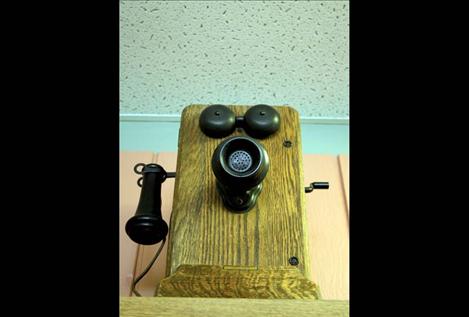
Far from today’s modern technologies like Wi-Fi, cellular phones, computers and satellites, Jay Sr. said the old telephone lines were called “party lines” because an average of 20 households would share a single line. 

If a customer wanted to place a call, they’d have to pick up the receiver and wait until no one else was using the line. 

“You heard everyone else’s conversations,” Judy said. “All calls were connected by the operator, and none of the phones had a dial.”

By Nov. 1 of 1960, Judy said every phone had a dial and a coded ring — a large improvement over the previous system.

Over the past half-century, technology has grown and expanded upon itself by leaps and bounds. 

As telecommunications is such an important industry in today’s modern economy, and as it holds the seemingly unlimited potential to connect people and ideas around the world, the ability to grow and adapt along with new technologies and methods of communication is essential. 

The locally-owned and family-run Ronan Telephone Company holds firmly to this idea.

According to President Jay Jr., RTC services about 2,800 telephone customers in the Ronan and Pablo area. More than half of these customers have a digital subscriber line — meaning they can use the telephone line to watch cable TV or access high-speed Internet. Over the past 10 years, RTC has purchased three different cable systems and now services St. Ignatius, Hot Springs, Plains, St. Regis, Darby, Thompson Falls, Superior and Seeley Lake. 

These changes are only the tip of the iceberg. In an effort to reduce prices for customers and increase economic viability in the region, RTC is once again expanding its technological capabilities and services.

In December, RTC partnered with another telecommunications company in Kalispell. Together, they bought a wireless data system in Libby that can be used to provide high-speed Internet or cable TV wirelessly through, “in essence, cell towers,” Jay Jr. said. 

Two years ago, Ronan Telephone received a $13 million grant from the Broadband Technology Opportunity Program and the Federal Department of Commerce’s National Telecommunications Information Agency. An American Recovery and Reinvestment Act project, the purpose is to expand a fiber-optic cable network from the Kalispell area to Elmo, Polson, Pablo, Flathead Lake’s east and west shores, Big Arm, Hot Springs, Camas Prairie and several communities surrounding Browning. The cable will then travel down U.S. Highway 93 and end south of Missoula — a total of 320 miles of fiber optics. Ronan Telephone will not be servicing Kalispell or Missoula, but simply connecting to them.

In addition, the Prestons entered into a partnership with a consortium of hospitals in the Kalispell area called the Health Information Exchange of Montana. The pact is lead by Kalispell and is intended to create a high-speed information network to connect patients and doctors throughout northwest Montana. Soon to be connected healthcare facilities include hospitals in Ronan, Libby, Cut Bank, Browning, Eureka, Whitefish, Shelby, Conrad, 12 smaller clinics, a long-term healthcare facility and home care facility. 

The consortium wrote a $30 million grant to fund the project in 2005, but only received half the required funds. Per the partnership, Ronan Telephone Company will assist in completing the project and, in return, will be able to connect from Kalispell to Libby and Pablo. 

This new, relatively massive cable network will connect the Mission Valley’s information systems network to Seattle, Wash., and negate the need for small to mid-level cable, Internet and telephone providers to pay other telecommunication companies (such as Quest or Century Link) for access to the outside world. 

Like other smaller telephone exchanges, Ronan Telephone Company currently leases a line that runs to Missoula in order for customers to “reach the outside world.” Leasing the line costs $10,000 per month. Judy explained that this cost is passed on to customers and plays a large part in the high data costs in rural areas. 

As an example, Jay Jr. said Frontier Communications in Libby charges $400 per unit for access to data. The exact same service and Internet speed in Seattle costs $15 to $20 per unit. 

“Because of this, it’s an economic disadvantage,” Jay Jr. said. “Even in Missoula and Billings, the price is double what it would be in a (larger) urban environment.”

He credits the large price gap between urban and rural service fees to a lack of competition in rural environments. Big cities tend to have several service providers vying for customers. He further explained that when a monopoly forms, citing Frontier Communications in Libby as an example, the price goes up. 

The Prestons hope the new fiber-optic system will create more competition and drive down the cost for customers while increasing Internet speeds and data technology throughout the area.

“Our mission is to narrow the gap between the urban and the rural (service provider prices) and connect into one of the most advanced systems in the nation in Seattle,” Jay Jr. said. 

Amid myriad other changes and advances in recent years, the Prestons have decided to change Ronan Telephone Company’s name to Access Montana and open a new office on U.S. Highway 93 near True Value Hardware. 

“We’re not only in Ronan, and we’re not only telephone anymore,” Judy said. “We serve several communities with Internet, phone and cable — that’s called the ‘triple play’ — and we’d like to offer that to everyone. That’s why we changed our name.”

Judy admitted to feeling a bit apprehensive about the name change, but stressed that the company itself was not changing hands nor moving to a different town, just expanding. 

“It’s a scary thing,” she said. “It gives my dad a little heartburn, and my mom’s first reaction was that she didn’t want to change it. She said in the board meeting that she didn’t want people to think we’re selling out, and we’re not. We’re not even technically changing the name, we’ll just be marketing and doing business as Access Montana.”

The company conducted a poll among customers to gauge their feelings on the subject matter. About 65 percent said they would be OK with the name change. 

“Our goal in life is to bring data prices down and make our region more economically viable to make us more competitive to places like Seattle, Spokane, Denver and Salt Lake,” Jay Jr. said. “According to our consultant, we’ll have the best router network in the state when this is done.”

Sponsored by: